
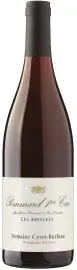

Domaine Cyrot-Buthiau - Pommard 1er Crus - Les Arvelets - 2022
Blend
100% Pinot Noir
Country
France
Region
Burgundy
Appellation
Pommard
UPC
0 15643 61740 9

Food Pairing
This illustrious representative of the Cote de Beaune with its dense and massive tannins revels in furred or feathered game, braised or roasted, which will
find in Pommard Premiers Crus an invaluable collaborator. Thick cut beefsteak, lamb, or stewed poultry will respond to its firm-textured tannins and
concentrated aromas. It is a natural partner for cheeses with well-developed flavors : Epoisses, Langres and Soumaintrain, but also Comte. Serving temperature : 14 to 16C.
Estate
For centuries Pommard has been considered the typical burgundy: deep red in color, powerfully aromatic, solid and trustworthy. The very name Pommard has
a generous ring to it and fills the mouth as it fills the glass. Pommard with its smiling vineyards lies between Beaune and Volnay where the Cote de Beaune
makes a slight turn towards Autun. These lands formerly belonged to the Dukes of Burgundy, to religious houses including the abbey of Citeaux, or to old families
such as the Marey-Monge family. As early as the Middle Ages, Pommard was thought of as the flower of Burgundy wines - the wine to which all others were compared.
The appellation, one of the first AOC to be so designated (1936), grows only red wines from the Pinot Noir grape.
Terroir
On the lower ground the soil is ancient alluvium. Mid-slope, the clay-limestone soils are well drained thanks to the inclusion of rock debris. Higher still are
Jurassic (Oxfordian) marls, brown calcic soils, and brown limestone soils. In places, the soil is reddened by the presence of iron. Exposure: south or east.
Altitudes : 250-330 meters.
Tasting notes
Its color is the deep, dark red with mauve highlights, its aromas are redolent of blackberry, bilberry, or gooseberry, cherry pit and ripe plum. At full maturity, it tends towards leather, chocolate and pepper, its firm but delicate structure, its fruit-filled mouth, and its chewy tannins create a truly unforgettable experience.
Description
Beware of preconceived notions! The fame of Pommard in the 19th century earned it the image of a wine that is both forceful and virile. In reality, time,
terroir and methods of vinification have all combined to create a more subtle reality, a wine that is both richer and more sensitive. Its color is the deep,
dark red with mauve highlights which caused Victor Hugo to speak of it as « night in combat with day ». Its aromas are redolent of blackberry, bilberry, or
gooseberry, cherry pit and ripe plum. Often, wild and feline notes develop with age. At full maturity, it tends towards leather, chocolate and pepper. It needs
to be given time to open up to its fullest extent and to display its mouth-filling texture, its firm but delicate structure, its fruit-filled mouth, and its
chewy tannins, which by then will be properly smoothed down. A rich wine? Certainly.
Vinification
Hand harvest.
Destemming : 100%
Fermenting time : 15 to 18 days
Maturing in Vosges & Allier oak barrels during 12 to 14 month
No Filtration
Technical data
Surfaces classified in Pommard : 206 ha
Surfaces classified in Pommard 1ers Crus : 115 ha
Maximum yield allowed : 48 hl / ha.
Alcoholic degree minimum/maximum : 10,5/14.
Alcoholic degree of our Pommard : 13C